
The AHEAD Study
The AHEAD Study is testing whether an investigational treatment can lower people’s risk of memory loss due to Alzheimer’s disease.

Cutting Edge Research
Researchers have learned that changes in the brains of people with Alzheimer’s disease start as many as 20 years before they notice symptoms like memory problems.
During those two decades, a protein in the brain called “amyloid” builds up in people who go on to have memory problems because of Alzheimer’s disease. While not all people with amyloid in their brain will develop memory problems, we know that the people who do are at a higher risk for developing the disease.
What is the AHEAD Study?
The AHEAD Study is comprised of two different clinical trials testing the same investigational treatment (known as lecanemab) in people who may be at risk for memory problems. Participants will receive a tailored dose of the study treatment, instead of a one-size-fits-all approach. Study participants are enrolled in one of two AHEAD trials based on the level of amyloid in their brain:
- Participants with intermediate amyloid levels take part in the AHEAD A-3 trial—the first ever trial aimed at stopping what may be the earliest signs of Alzheimer’s disease. Participants in the AHEAD A-3 trial will receive lecanemab once every four weeks for four years.
- Participants with elevated amyloid levels take part in the AHEAD A-45 trial. Participants in the AHEAD A-45 trial will receive lecanemab once every two weeks for about two years and then once every four weeks for the remainder of the study.
Participants in both trials will receive intravenous (IV) infusions of lecanemab, tailored to their risk of developing memory loss, or a placebo, an inactive substance designed to mimic the appearance of the investigational treatment. The infusion takes approximately 60 minutes.
At different points in the study, participants have a PET scan (or Positron Emission Tomography brain scan), to look at amyloid and tau (another protein) in their brain. This helps the participants and researchers track their health. The PET scan takes pictures of participants’ brains, allowing researchers to see and track changes in amyloid and tau levels.
Our study is the first of its kind to:
- Enroll participants as young as 55 years old who are at risk of developing symptoms of Alzheimer’s disease as they get older;
- Use a blood test to rule out people not likely to be eligible based on amyloid PET imaging;
- Target the earliest changes in the brain due to Alzheimer’s disease by enrolling participants with intermediate levels of brain amyloid;
- Use an approach that tailors dose levels of the investigational treatment to study participants’ brain amyloid levels;
- Test an investigational treatment that aims to get AHEAD of Alzheimer’s disease.
What is "Amyloid"?
- A protein called “amyloid” builds up in the brains of people who often go on to develop Alzheimer’s disease. Study participants underwent brain scans to determine if they had amyloid build-up.
- While not all people with amyloid in their brain will develop Alzheimer’s disease, people with elevated levels of amyloid are more likely to develop symptoms of Alzheimer’s disease.
- The AHEAD Study tests whether an investigational treatment can lower the amount of amyloid in the brain and delay or prevent memory problems.
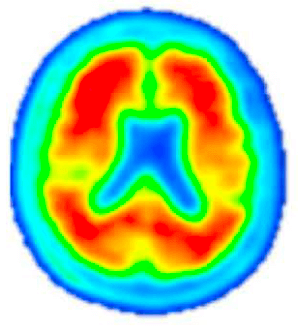
Amyloid PET Scan
Pre-Investigational Treatment
Post-Investigational Treatment
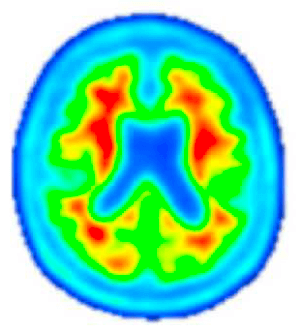
Amyloid PET imaging scans from a representative participant with symptoms of AD in the Phase 2 trial of lecanemab—the investigational treatment being tested in the AHEAD Study. Amyloid PET scans measure the levels of amyloid plaque in the brain. The image on the left is taken before the participant has started on the investigational treatment. The image on the right is taken after 18 months of investigational treatment with lecanemab, indicating a reduction of amyloid plaque burden in the brain. (Data presented at AAIC 2019). The AHEAD Study investigates the effect of lecanemab on amyloid levels in participants without symptoms of AD.
About lecanemab:
The investigational treatment being tested in the AHEAD Study
On July 6, 2023, lecanemab was granted full approval by the Food and Drug Administration (FDA) to treat people who already have mild cognitive impairment or mild dementia due to Alzheimer’s disease (often referred to as early Alzheimer’s disease).
Lecanemab was first granted accelerated approval based on its ability to reduce amyloid plaques in the brain in people with early symptomatic Alzheimer’s disease. It has since received full FDA approval after clinical trials showed that reducing amyloid plaques was associated with a slowing of cognitive decline. Ongoing and real-world studies have shown that the safety profile observed in clinical trials is generally consistent with use in broader patient populations. In clinical care, lecanemab is used only in individuals with early symptomatic Alzheimer’s disease, and a newer maintenance option allows for ongoing treatment with a weekly injectable form after an initial period of intravenous infusions.
The AHEAD Study aims to build on the positive results that lecanemab showed in people with mild cognitive impairment and mild dementia.
This study is testing lecanemab in people who have no cognitive symptoms of Alzheimer’s disease but who have amyloid present in the brain. Researchers are studying whether starting study treatment before symptoms begin may help delay or prevent cognitive decline. Because participants in this study are cognitively unimpaired, lecanemab is considered investigational in this population and is not currently available as standard clinical treatment for individuals without symptoms but with amyloid pathology.
Study Leadership
The study is funded by the National Institutes of Health, in partnership with the pharmaceutical company Eisai. It is being conducted by the NIH-funded Alzheimer’s Clinical Trial Consortium (ACTC), a network of leading academic Alzheimer’s research centers.
The AHEAD Study has approximately 100 study locations worldwide, including in North America, Japan, Singapore, Australia, and Europe—more than 70 of which are in the United States and Canada. The study is led by Alzheimer’s disease research experts and academic leadership at the University of Southern California’s Alzheimer’s Therapeutic Research Institute, Brigham and Women’s Hospital, Massachusetts General Hospital, and Harvard Medical School.
The academic researchers leading the design and implementation of the study are:

Paul Aisen, M.D.
Director, University of Southern California Epstein Family Alzheimer’s Therapeutic Research Institute

Reisa Sperling, M.D.
Professor of Neurology, Harvard Medical School
Director, Center for Alzheimer Research and Treatment, Brigham and Women’s Hospital and Massachusetts General Hospital

Keith Johnson, M.D.
Professor of Radiology, Harvard Medical School
Director of Molecular Neuroimaging, Massachusetts General Hospital
Neurologist, Brigham and Women’s Hospital

Help Us Get AHEAD of Alzheimer's Disease by Working Closely With World-Renowned Researchers
The AHEAD Study
The AHEAD Study is testing whether an investigational treatment can lower people’s risk of memory loss due to Alzheimer’s disease.

Cutting Edge Research
Researchers have learned that changes in the brains of people with Alzheimer’s disease start as many as 20 years before they notice symptoms like memory problems.
During those two decades, a protein in the brain called “amyloid” builds up in people who go on to have memory problems because of Alzheimer’s disease. While not all people with amyloid in their brain will develop memory problems, we know that the people who do are at a higher risk for developing the disease.
What is the AHEAD Study?
The AHEAD Study is comprised of two different clinical trials testing the same investigational treatment (known as BAN2401 (lecanemab)) in people who may be at risk for memory problems. Participants will receive a tailored dose of the study treatment, instead of a one-size-fits-all approach. Study participants are enrolled in one of two AHEAD trials based on the level of amyloid in their brain:
- Participants with intermediate amyloid levels take part in the AHEAD A-3 trial—the first ever trial aimed at stopping what may be the earliest signs of Alzheimer’s disease. Participants in the AHEAD A-3 trial will receive BAN2401 (lecanemab) once every four weeks for four years.
- Participants with elevated amyloid levels take part in the AHEAD A-45 trial. Participants in the AHEAD A-45 trial will receive BAN2401 (lecanemab) once every two weeks for about two years and then once every four weeks for the remainder of the study.
Participants in both trials will receive intravenous (IV) infusions of BAN2401 (lecanemab), tailored to their risk of developing memory loss, or a placebo, an inactive substance designed to mimic the appearance of the investigational treatment. The infusion takes approximately 60 minutes.
At different points in the study, participants have a PET scan (or Positron Emission Tomography brain scan), to look at amyloid and tau (another protein) in their brain. This helps the participants and researchers track their health. The PET scan takes pictures of participants’ brains, allowing researchers to see and track changes in amyloid and tau levels.
Study Leadership
The study is funded by the National Institutes of Health (NIH), in partnership with the pharmaceutical company Eisai. It is being conducted by the NIH-funded Alzheimer’s Clinical Trial Consortium (ACTC), a network of leading academic Alzheimer’s research centers.
The AHEAD Study has approximately 100 study locations worldwide, including in North America, Japan, Singapore, Australia, and Europe—nearly 75 of which are in the United States and Canada. The study is led by Alzheimer’s disease research experts and academic leadership at the University of Southern California’s Alzheimer’s Therapeutic Research Institute, Brigham and Women’s Hospital, Massachusetts General Hospital, and Harvard Medical School.
The researchers leading the design and implementation of the study are:

Paul Aisen, M.D.
Director, Alzheimer’s Therapeutic Research Institute

Reisa Sperling, M.D.
Professor of Neurology, Harvard Medical School
Director, Center for Alzheimer Research and Treatment, Brigham and Women’s Hospital and Massachusetts General Hospital

Keith Johnson, M.D.
Professor of Radiology, Harvard Medical School
Director of Molecular Neuroimaging, Massachusetts General Hospital
Neurologist, Brigham and Women’s Hospital